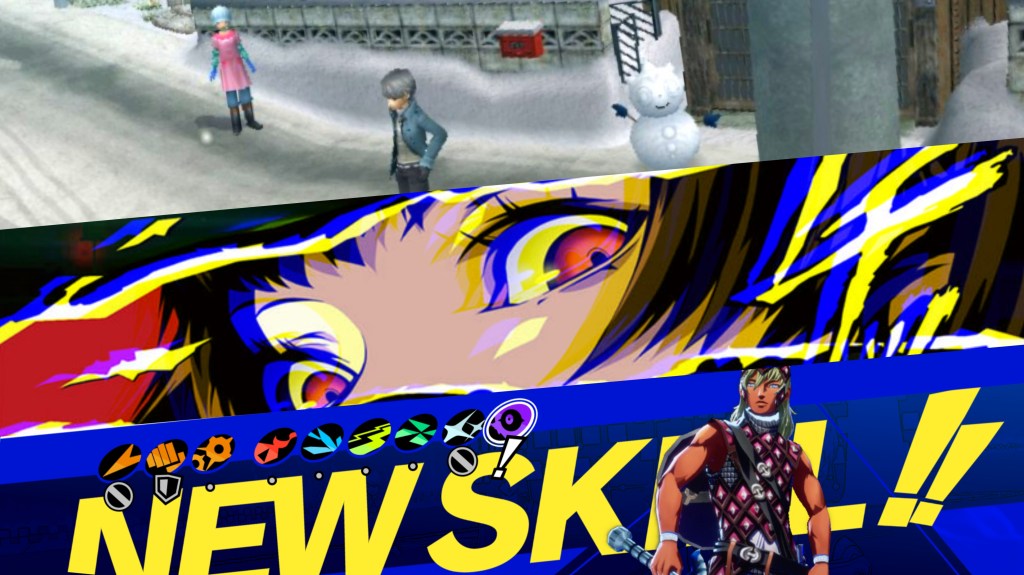
On a large, overhanging screen within a dimly-lit videogame store in March of 2009, my gaze gradually fixated on a trailer that would alter the course of my life. A sharply-dressed Japanese kid with silver hair closed his fist and manifested a gigantic, colourful monster to attack his enemies, then a second later was shown working a boring dishwashing job in a sleepy town before looking into a murder mystery plot. This brazen mix of disparate parts apparently called itself Shin Megami Tensei: Persona 4, and in the desolate JRPG landscape of the very late 2000s it had the gall to release on the years-obsolete Playstation TWO. I was immediately struck by its confidence and style, and got myself a copy as soon as the game was available.
Need I say what happened next? Well you’ve probably met a Persona fan or two, dear reader; you know what happened next. But I’m still going to talk about it. As we rapidly approach the next major release from the head honchos of Persona development, the heinously-named Metaphor: Re Fantazio, I present my own personal retrospective of a truly incredible RPG series.
“The First One You Play is Probably Your Favourite”
It was a slow, gradual realisation, but by 2009 I knew I liked Japanese Role-Playing Games: Pokemon Yellow had been my first videogame, after all, and I had also sunk a weird amount of time into that turn-based Harry Potter and the Chamber of Secrets Game Boy game; then when I was lucky enough to acquire a GBA a few years later it came with the unique lightning-in-a-bottle moment that was Golden Sun. In the ensuing years, the likes of Final Fantasy Tactics Advance, Tales of Symphonia, Paper Mario: The Thousand Year Door, Kingdom Hearts (vicariously) and eventually the DS remake of Final Fantasy IV would help me determine enough of the incidental characteristics shared by members of the genre to convince me of my taste for them. So come to think of it, that fateful 2009 Persona moment was probably the earliest time in my life I saw a game without a single shred of understanding of its history, recognised it as a JRPG, and bought it primarily on that basis.

But as we all know, a Persona game isn’t ‘just’ a JRPG; the series offers quite a bit to distinguish itself from the crowd, and chief among that list is style. The very first thing that greets you when you boot up Persona 4 is a lavish, provocative music video heaving with equal parts grimy retro-tech nostalgia and sharp yellow/black contrasts dialled right in to the contemporaneous 2000s Apple marketing playbook. The lyrical essays scrolling past in every direction to mimic the information overload within those very lyrics made an indelible impact on me as a millennial teenager whose active memories stranded both sides of the social media divide; I was instantly drawn in.
That love of yellow and black persists throughout the game’s striking UI, which also marks menu transitions with a neat faux-CRT TV colour-banding effect reminiscent of modern-day Netflix branding. And that tune was an instant ear-worm, a chaotic Shoji Meguro instant classic solidified by its presence on an honest-to-goodness soundtrack selection CD included as standard in that PS2 game case – the first game I can remember owning that did so. I wore out the tracks on that disc long before I heard them within the game, and the identity of the Persona series as an audiovisual feast unimpeded by ageing hardware was unmistakable from my very first day with it.
Beyond this clear stylistic identity, Persona 4 is defined by its intimate small-town scale, filling out a small cast of characters with layers upon layers of depth and going to some uncomfortable – not to mention ambitious and a teensy bit Jungian – thematic places without ever losing a sense of warmth or its perfectly-balanced humour over a year-long main story. The idea of a narrative taken day-by-day, filled with small relatable choices bearing meaningful consequences but never overwhelming in number, was absolutely delightful. It would be many years before brute force and hindsight would help me empathise with fans who had jumped on the Persona train with the groundbreaking Persona 3, a game with a much darker and edgier presentational wrapper around it and a greater emphasis on plot over levity or egalitarian character study. But for me, the damage was done: this mellow, vibes-first creative direction was Persona to me.
And yet I did not complete the original PS2 version of Persona 4. I barely reached 25 hours, to be honest. After all, it was the only reason I had to go back to the PS2, and there were much more shiny newer-gen (and portable) games coming out at the time. Not to mention the game was hard; I’d never experienced anything from the Atlus school of RPG design before, and the original version of P4 did not hold back on those boss fights, nor did it have much respect for save points. Luckily, my history with the game does not end there.
Tempered in Gold
Fast-forward three and a half years to the turbulent first year of the Playstation Vita. The handheld console’s sales were soft to put it mildly, and there can be little doubt the Vita’s launch was poorly handled. I, however, was in love with the pocket powerhouse, and was fiending for any new game I could play on that gorgeous OLED panel. A new version of Persona 4 sounded beyond perfect for what promised to be a busy 2012 holiday season, but the English-localised release would only make November over in the US; Australia would have to wait until late January 2013. But I simply could not stomach the anticipation, so I bit the expensive import bullet as I had done a few times before.

Amusingly enough, Persona 4 Golden would be the last game that would ever prompt that decision for me, as mere months later the reveal of Pokemon X / Y as the first simultaneous worldwide releases in that series would permanently shift the attitudes of game publishers and ensure that if a major videogame was in English, Aussies would forevermore receive it the same day as Americans. But I didn’t know that, and I probably wouldn’t have cared anyway. It didn’t really matter that I had fallen off its previous iteration; I just wanted a meaty JRPG for my new handheld, and even if it couldn’t recapture the magic of that PS2 original, I thought I might be looking at my Golden ticket to get some proper value out of that Vita.
You might say that turned out correct.

Persona 4 Golden is one of my top five favourite videogames of all time, and has been stuck on that shortlist for over a decade. You see, it turns out that 2012 holiday season was a bit of a challenging one for me personally, and a portable window into a world that oddly cozy, that unconventionally compelling, that outright engrossing, could hardly have arrived at a better time. I have been lucky enough in my life that I’ve rarely needed videogames as a source of pure escapism, but during that November-January window, P4G was the only game I cared about. I distinctly remember one December day I just stayed in my room without even opening the curtains, curled up with only enough energy to cradle that handheld and book it through the Void Quest dungeon. I had never done that before and thankfully haven’t since.
P4’s piled-up-CRT music video may be seared into my brain, but I have a near-Pavlovian reaction to the screeching harmonica that kicks off Golden’s intro video. Come to think of it, despite that soundtrack CD, I couldn’t fully appreciate the distinct, funky musical identity of Persona 4 until the Vita version gave me the chance to finish* it, and the extra tracks were just delectable icing on an emotional cake. What’s more, the game’s famous real-life/monster-fighting hybrid gameplay genuinely taught my young brain the benefits of both time-management and a strong network of relationships in one’s life; that might sound awfully basic, but I’ve read enough articles and watched enough YouTube videos over the years to know I’m not the only one who feels that way about a Persona game.
The myriad changes and improvements over the base 4, which I catalogued crudely in one of my earliest blog posts, elevated the experience to such an extent that P4G became the Playstation Vita’s unofficial “killer app”, the top title on almost every recommendation list. It turned plenty of curious people into JRPG fans and, thanks to a groundswell of praise among the videogame press, raised the profile of the series to the point where all it needed was a new game on a console that wasn’t horribly mismanaged, and it might just take off. Which of course brings us to…
Sometimes, You Do See It Coming
The mid-2010s were a fun and oh-so-frustrating time to be a Persona fan. The success of Persona 4 brought about an avalanche of spin-offs within some left-field genres, not to mention the truly unhinged and inimitable Catherine (my first-ever review on this site), but the main event showed itself at the beginning of 2014. A vague yet stylish teaser led fans to believe there would be a new main-series entry in their hands – albeit once again on a last-generation system – within the space of two years. Persona 5 was the primary reason I kept my PS3 for years after the launch of the PS4, and yet it would not be until April 2017 that Persona 5 would land in the West, on the Playstation 4 after all, and with an almighty crash that sent waves through the industry.
It’s a tad embarrassing to admit all these years later, but to this day the block of vacation time I took in order to play through Persona 5 and avoid spoilers remains the longest I have ever bitten off at once – and it still wasn’t enough to complete the game. Sure, I wasn’t playing it every second of those three weeks – I was in a better place overall by then and tried not to burn myself out on the game – but it was still my main priority after years and years of hype build-up. And as any recent reader of this site will be tired of hearing, expectations will do things to you.
Of the three “modern-style” Persona games, my relationship with 5 is the most complicated. I did finish the game shortly after that block of time off, making it the only non-portable Persona game I’ve ever seen through, but I had an eye-watering 136-hour save file to show for it. That marked the second time in my life a single-player videogame had claimed a triple-digit hour count from me (barely a month after The Legend of Zelda: Breath of the Wild had become the first), and I don’t think it quite earned all of those hours.
Persona 3 and 4 are certainly wordy games, but the rivers of chatter that permeate 5’s plot are legendary. The vocal performances are fantastic – and in many cases star-making – but the anxiety of the writers/localisers to portray some specifically of-the-moment Japanese political themes can bog down sections of the narrative. Even innocuous moments in the story will often have multiple characters repeating the same ideas in different ways, as if scared the audience missed something the first time. For better or worse, Persona 5 found developers P-Studio at the peak of their “not respecting players’ time” arc, which is to say nothing of the significantly longer Persona 5 Royal.

Of course, the intended effect of such a long time spent with a core cast is that you tend to grow rather fond of them, and that is absolutely a huge strength of the game. Its sheer sales success means the vast majority of the people who played Persona 5 had never played a Persona game before, and those people were not ready for the power of the series’ gameplay and story loop to draw you right into its world and keep you there. Those poor, unsuspecting souls. That tendency to draw out a scene also enriches the game’s most emotionally resonant moments: I will remember those magnetic few hours after the game’s major deceptive twist in the interrogation room for as long as I live.
The visual style of the prior games is also comprehensively left in the dust by P5, which has become somewhat of a poster child for fashionable function in videogame user interfaces, as snappy as it is ostentatious. Red and black may have been a winning aesthetic long before Persona 5, but this game well and truly made the look its own, simultaneously making every other videogame menu look terrible with its unreal transition animations and pushing the turn-based RPG genre forward with its deceptively simple single-button shortcuts extending in all directions. There’s also no contest as to which title in the series features more consistently-rewarding gameplay; almost every activity you choose to do, every person you choose to hang out with, in Persona 5 will reward you in some tangible way that improves another aspect of the game’s carefully-balanced systemic tapestry.

And the music! Shoji Meguro may have proved his genre-bouncing genius with the other Persona titles, but the sheer momentum present in even the least important tracks throughout 5 is something to behold. You really get the sense of a story that is always moving, which helps counteract all the content working to slow it down. New primary vocalist Lyn Inaizumi lends an earthy gravity to a long list of feature tracks that have transcended the game: Rivers in the Desert, Life Will Change, and The Whims of Fate are hall-of-fame-level JRPG gems, but Beneath the Mask is in my opinion one of the greatest multi-purpose background tunes I have ever heard, in any medium, ever. It just never gets stale no matter how long it’s on.
Regardless of my hangups, Persona 5 is absolutely one of the best games I have ever played, and it deserves its status as the trailblazing title that hurtled Atlus into the mainstream. But its length brought me to a crossroads of sorts, and I would strive to do things a bit differently with the next Persona game I played.
Mortality Blues Come in Twos
My long dalliance with Persona 3 has been a bit of a rollercoaster. Some time between the releases of Persona 4 and Persona 4 Golden I got myself a PSP and imported a copy of Persona 3 Portable, a curious videogame re-release if ever there was one. Massive improvements to combat and quality of life are counterbalanced by restrictive (though quick) menu-based traversal and a general limit to visual scope. Once again, I didn’t complete this version of the game on first attempt (I bought my PSP very late in its life and the Vita was not that far away by then), but much like Persona 4 set the default tone for the whole franchise in my book, the unique music, character interactions and vibe of the female protagonist route set the default tone of Persona 3 as far as I was concerned. The game’s menus were pink, the battle music was Wiping All Out, the halls of Gekkoukan were not walkable; this was my established P3 reality.
And so, over a decade later when Portable reappeared as a HD-upscaled Xbox Game Pass title, I went back to that reality, and this time I was on a mission to see it through at long last. Thanks to the Ayaneo Air Pro, such a project was within reach, but a shift had also occurred in my personal attitude towards Persona gameplay: I decided the FOMO that pervaded my P5 playthrough and only added to that massive hour counter would be a thing of the past, and I would traverse the in-game year with the aid of a spoiler-free daily guide.
The Persona community has become extremely good at writing such guides over the last couple of decades, and so I was still hit hard by almost every big story moment – even the ones I had accidentally had spoiled for me over years of fan discussions. I highly recommend considering this way of playing if you are reading this and thinking about starting a new Persona game, especially if it isn’t your first Persona. You do lose that fun illusory sense of freedom when deciding how to spend your time, which is arguably a huge part of the initial appeal of the series, but you don’t lose much else. If you are not the type to want to play a 100-hour game more than once, I strongly believe it’s worth thinking about.

Speaking of playing a 100-hour game more than once, I did manage to finish P3P after a couple of reasonably focused months, but I barely had time to (metaphorically) punch the air in celebration before Atlus announced a full ground-up remake of the base Persona 3, set to release roughly a year after the first Game Pass drop. The conflicting emotions I felt as the reality of this announcement washed over me are difficult to describe; my stomach was sinking at the same moment my eyes were lighting up at the game’s striking new look.
Anyway, another year passed and Persona 3 is now somehow my most-played Persona game. I have finished it twice, with both the male and female protagonist routes in the books, and all the differing social links explored. It was never going to topple Persona 4 Golden for me, but it’s a pretty phenomenal game, especially in the shiny new guise of Reload, which I won’t talk about specifically in this article because it’s eligible for a few entries on the 2024 end-of-year lists.
What I will say is that playing 3 after the other two games in the “modern Persona trio” is a real trip, as series staples simply taken for granted in 4 and 5 – like the mechanics beneath the ability to summon personas in the first place – are explored in gruesome, edgy 2007-emo detail. The death-tinged undertones of the other two stories stand at the forefront of this one, and while levity is still present in the script, there’s a heaviness that hangs above proceedings just about the whole way through the game. The greatest counterbalance to this is not a generous dose of comic relief, but rather the soundtrack, which despite liberal minor-key usage is dominated by upbeat, iconic Lotus Juice hip-hop that has had nerds toe-tapping for years and years.
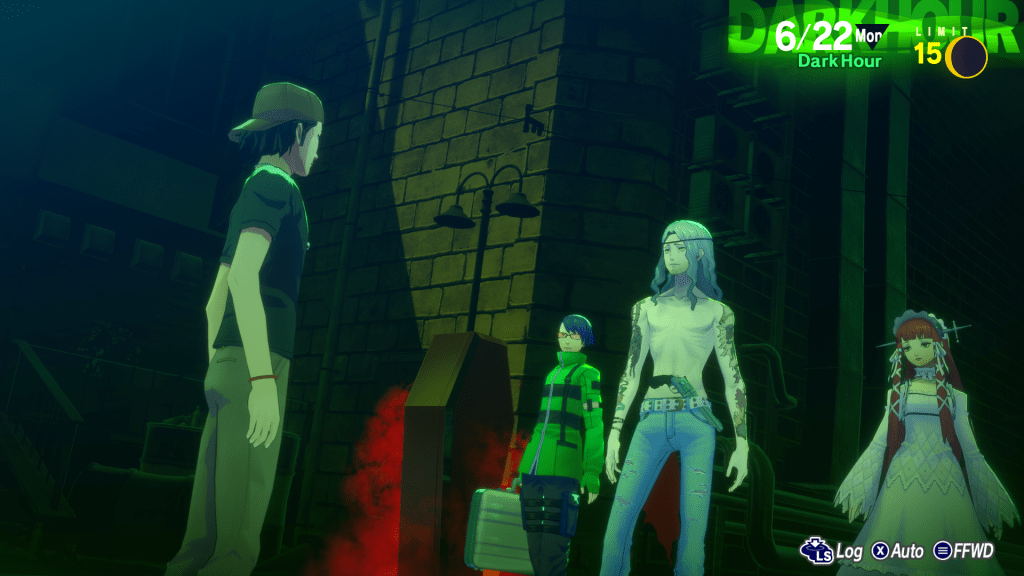
The core cast develops in a far more linear fashion than those of P3‘s younger siblings, as depth is doled out in accordance with how much of the year you’ve seen rather than how much side-story progress you’ve made with an individual party member. The advantages of this approach are plain to see for those lucky few that do enjoy the spotlight – especially those whose time is cut tragically short – but it’s bad news for almost every second-tier character in the game. With one or two notable exceptions, the social link side stories in Persona 3 are the series’ weakest, and I don’t just mean in terms of gameplay benefits. But this was the first game to present such stories, so it’s perhaps somewhat unfair to dwell on that aspect when so much of the rest of the experience is so well-tuned and memorable.
— — —
By my conservative estimate, I have put a tick under 500 combined hours into the Persona series over the last fifteen years. Only Pokemon, Zelda, Halo and Final Fantasy outstrip those numbers, but two of those franchises only do so thanks to multiplayer support, and the other two can each boast at least four times the amount of individual games that Persona has to offer. When you devote that much of your time on this earth to what ultimately amounts to just three meaty stories, those stories are going to leave an impact on you. If you have somehow reached the end of this retrospective and still have yet to experience a game in this wonderful series firsthand, I can think of few recommendations I’d give more wholeheartedly. Just be ready for your life to change.
*I didn’t even get the True Ending in Persona 4 Golden and it’s still one of my favourite games in all of history

 Vagrant Rant