Posts Tagged ‘Game’

Very Quickly Breaking Down an Almost-E3 to Remember

Geoff Keighley, you son of a gun.

The actual 2025 Summer Game Fest show may not have been one for the history books, but something has clearly shifted around the event by now. Despite the largest console launch in gaming history just days earlier, and an ongoing reluctance from the big-boy publishers to allow their messaging to clash with that of their rivals, the light shining from Geoff’s would-be E3 replacement in 2025 was too irresistible to ignore for too many important names, and we ended up with an unusually dense June showcase season.

Because I only just put up a monster post for the Switch 2 launch, this annual show analysis will be much shorter, less formatted, and perhaps slightly more unhinged than usual, but I wasn’t going to miss doing one anyway.

The first of the big names to show themselves in that sweet early-June hype slot was – rather surprisingly – CD Projekt Red, who teamed up with Epic Games to release a mighty impressive State of Unreal demo for The Witcher 4 at this year’s Unreal Fest. The demo was so impressive, in fact, that the comparisons to that infamously overambitious E3 2012 Watch_Dogs trailer immediately came out in force among YouTube commenters. More like Un-Real, am I right?

All that said, despite the old-school E3 stage vibes of the presentation I am slightly more inclined to believe this crazy demo – which is purported to run at 60 frames per second on a base PS5 – is more likely to lead to something comparably playable than that fateful Ubisoft misdirect over a decade ago. Epic has already proven that Unreal Engine 5 can improve its capabilities and efficiency through the games releasing on it, and CD Projekt just proved with Cyberpunk 2077 on the Switch 2 what they are willing to do in the name of optimisation. Cautiously exciting stuff that started the season off with a bang.

“Live service games? What are those?” mused a pensive Playstation as they kicked off one of the best State of Play shows ever with the glorious return of Lumines. The company’s traditional tendency to ignore Summer Game Fest in nonchalant fashion and do their own thing now looks suspiciously like a multi-year plan to circle slowly around the June hype season until they can go before Xbox; I joke, of course, as not much about Playstation’s last five years screams “well-planned”, but if they bring the heat like this again we will be in for some good-old-days June appointment viewing.

The flavour of the 2025 State of Play could hardly be more different from that of last year, as even third-party online multiplayer game mentions were kept to a blatant minimum. The cheeky return of Pragmata set off my Capcom-streak alarm once again – the game is looking fabulously different from anything else in their current catalogue – and closing with an all-new Arc System Works Marvel fighter could not have shouted “hardcore traditional audience” any louder from the proverbial rooftops (announcing a new official Sony fight stick came close though). Elsewhere, the return of Suda51 via Romeo is a Deadman (a title that not-so-subtly pairs with the protagonist of Lollipop Chainsaw) will always be welcome in my house, it’s great to see the ongoing survival of the Bloodstained and Nioh series, support for Astro Bot remains stellar, and Final Fantasy Tactics LIVES! More of this please, Sony.

Continue reading
At Last, We Switch 2 a New Era

Nintendo’s eighth generation has begun. The previous one lasted a gargantuan 98 months and two days, and it was very very important to the fortunes of the company, but it has finally run its course, and now here we are at the end of the successor’s long maiden weekend. The Nintendo Switch 2 is in our hands, and tons of people around the world have begun to put it through its paces, proverbial microscope at the ready.

If you think I’m not one of those people, you must be new here. Welcome!

Party Platform

Over the last four days I have played the Nintendo Switch 2 at five different locations, in ten different groups of people, online, offline, on TVs, propped up on cafe tables, in bed and on public transport. No matter what conclusions you may draw from the rest of this rather large article, it remains worthwhile to mention that this is still Nintendo’s competitive advantage in 2025; they do wide-demographic multiplayer better than any other major platform holder, and they do it in a myriad of different ways. The Switch 2 is just as flexible and even more social than its trailblazing older brother, and just in case that conclusion gets lost in all the nerdy minutiae to come, it goes right up here at the top of the page.

Hardware? I Hardly Know Her

Now let’s get straight into the needlessly granular hardware observations and comparisons you all know and tolerate.

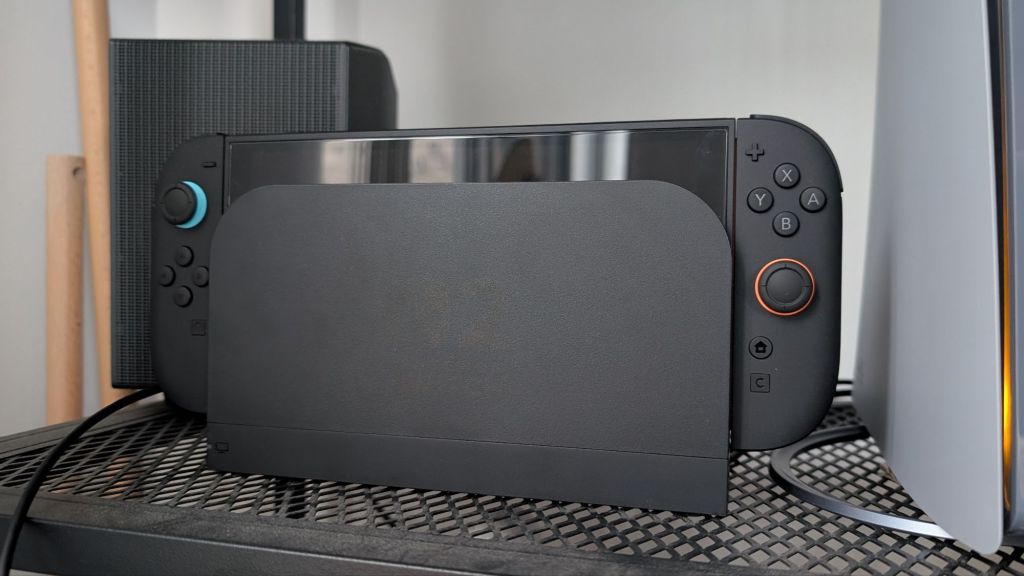
The Switch 2 is definitely a nice bit of kit out of the box, and the first thing I noticed is something I hadn’t heard any preview explicitly mention: the dominant colour of the machine. When assembled in handheld mode, this console presents a clean, unified visual that’s a far cry from the middling greys of the Switch 1’s short-lived launch joy-cons, which only made the thick black bezels of the 2017 model stand out even more. The Switch 2 may technically still be on the darker side of the grey spectrum if you want to be a giant nerd about it, but for all intents and purposes this handheld is black, and it looks good in it.

It’s also large, though the box in which it ships is somehow noticeably smaller than even the already-shrunken OLED box. The roughly 8-inch screen and significant power/battery jump up from the first Switch necessitate a wider frame, though the Switch 2 really doesn’t feel as big – or heavy – as it looks; that’s probably down to a remarkably thin breadth. No portable PC handheld I have tried – and I’ve tried a fair few – is even close to this narrow, and that helps with the weird illusion of lightness despite the screen size. It’s only when you look down its edges and notice how tiny all the buttons and compartments are – with the notable exception of the relatively giant lower air vents – that the size hits you again.

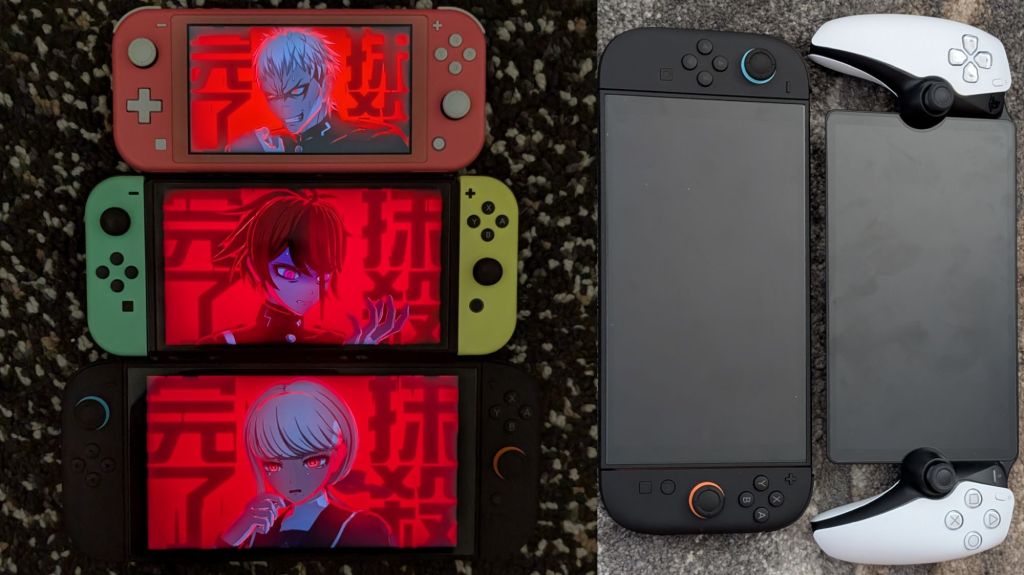
As for the screen itself, pros and cons are undeniably in play. All the pre-release hubbub about the Switch 2 lacking an OLED panel will almost certainly prove irrelevant to the vast majority of people, as the LCD technology Nintendo uses has come on in leaps and bounds in the last six years. The 1080p screen is much more comparable to the one on the Playstation Portal remote player this site dissected last year, both in size and vibrance. In the picture below, you can see some classic light bleed around the edges of the Switch Lite that isn’t there on the 2. However, it’s still undeniable in person that the Switch OLED (not to mention the AyaNeo Air handheld PC also covered in that 2024 article) runs rings around the launch Switch 2 as far as black levels, contrast and even brightness are concerned.

The biggest immediate difference from the Switch 1 beyond stature is the magnetic attachment mechanism behind the new joy-cons, and they do indeed jump on with a satisfying clap. The magnet on each edge is strong enough to feel like it takes over control once the “Joy-Con 2s” are inside the colour-coded divots, yet weak enough that you can’t, say, attach the two components from within their plastic bags right out of the box. At least in week 1, my Switch 2 isn’t showing any signs of loose or bendy joy-con connection; everything feels almost like one piece in handheld mode.

Continue reading
The Seven Stages of Videogame Re-Releases

It’s been a topic at the forefront of gaming for at least three console generations: the videogame industry is now old enough to look back and draw from its past, and in an age where some games of yore are ridiculously difficult to experience with anything approaching legality, re-releases distinct from their original source in all manner of ways are as commonplace as they are guaranteed to attract online discontent. In many cases, they also represent a near-guaranteed source of revenue for publishers keen on mining nostalgia, so whether you love them, hate them, or pay them no mind until one of your favourites arrives in the spotlight, they aren’t going anywhere.

What I find most interesting about the modern re-release is that the quality and even validity of a given project oftentimes seems to hinge on what labels people are willing to attach to it. As with most things in life, enjoyment is regularly determined by expectation, and the wrong label can instantly diminish the hard work of thankless development teams, sow confusion over lengthy production cycles, or encourage needlessly circular pricing debates. So I feel like it’s worthwhile to break down and categorise those very labels as I see them defined today.

Because seven is a poetic number that looks great in post headers, that is how I have attempted to divide them – even if I have to stretch a bit to do so. It’s all just one person’s take after a couple of decades following the videogame industry – and I can definitely see people disagreeing on the order of the categories – but I’ve tried to articulate with examples as best I can.

Port

Your basic “Take Game A from Platform B and get it to run on Platform C” situation. Nothing more, nothing less. This is regularly seen when a period of platform exclusivity breaks and a title shows up on a competing one within the same generation. Because timed exclusivity within the console space is a rarity nowadays, the platform that is usually either early or late to the party is the PC, but you see more variety of circumstance the lower down you go on the production budget scale. For every big-budget early access title on the Steam/Epic Games storefront, every surprising eleventh-hour Yakuza/Square RPG arrival, there’s a “Nindie” debuting on Switch first, a small ID@Xbox game flying the Game Pass flag straight out of the gate, a former Apple Arcade exclusive that manages to find an unlikely second life somewhere else. When these games inevitably cross over to find new homes – grabbing a handy second wave of buzz in the process – they invariably do so without significant gameplay changes or extra content that hasn’t already been added to their initial versions.

The overwhelming majority of PC ports do offer more flexible graphical options due to the open nature of the PC environment (usually related to resolution, frame rate caps/unlocks, and previously unavailable visual effect toggles), just as a huge amount of Switch ports require technical downgrades by very imaginative and talented people in order to run at all (The folks at Bluepoint, Nixxes, and Panic Button come to mind). But if that’s all she wrote, you’re looking at a bread-and-butter port. There are many who hold the untouched port as the most ideal form of game preservation, and many more who don’t see the point of a fresh release of an older game if the developers don’t update anything, but the simple fact remains that basic ports allow more people to play more videogames and they’re an unavoidable part of the landscape.

IT’S A PORT IF: it shows up on a different platform from the original release, and barely anything has changed beyond what the new platform inherently offers to its games.

Enhanced Port

A game qualifies as an enhanced port in my mind if there has been little to no discernible graphical work done under a game’s hood since its original release, thereby qualifying it as a straight port if not for one or two clear and way-too-significant gameplay changes that have been implemented. Weirdly enough, this opens the door for re-releases to occur on the same platform as their source material, a practice for which the Kingdom Hearts franchise used to be infamous and something the Pokemon main series did with immense success right up until 2020, when it switched to a DLC Expansion strategy instead. The concept of an enhanced port definitely represents a curious semantic pocket of the industry, because while you can theoretically port a game to the platform it’s already on, without any noteworthy enhancements such an endeavour would be literally pointless.

Of course, most of the qualifiers for this category actually do cross over to new platforms, and as you might expect if you’ve invested in any of their recent consoles, Nintendo features heavily among them. The notoriously port-happy Big N greenlit an almost exhaustive catalogue of exports from the tragic Wii U to the hit-making Switch over its long life to give the a stranded titles a chance at sales, each packing little more than a resolution bump in the visuals department but almost always carrying a smattering of bullet points to set the new version apart.

For example, Hyrule Warriors Definitive Edition packs new character skins and integrates content from multiple previous versions of the game, New Super Mario Bros U Deluxe and DK Country Tropical Freeze add new characters and abilities, Super Mario 3D World + Bowser’s Fury adds, well, Bowser’s Fury, and Mario Kart 8 Deluxe fundamentally changes the flow of gameplay with more granular kart stats, tweaked balancing and an extra item slot per player (in addition to new characters). Older instances include the Gamecube release of Sonic Adventure 2 with an entire multiplayer mode in tow, the transformed controls and gameplay balance of Resident Evil 4‘s Wii edition and the enabling of the mythical “Stop n’ Swap” functionality in the Xbox 360 version of Banjo-Kazooie.

IT’S AN ENHANCED PORT IF: it basically looks / sounds the same, but substantial gameplay content has been added or even changed.

Continue reading

The Winners and Losers of Summer Showcase Season 2023

Another one has come and gone (mostly – a few smaller shows may still appear around the place): though the name of the period may change, the last 4-5 weeks have unmistakably been the match of any classic E3 period for bedazzling game reveals, gleefully inconsistent presentations and feverish chatter. Because no time of year is more conducive to wildly unfair oversimplification, let’s sum up the fun via a strained list of quickfire winners and losers.

Winner: The Big Three Showdown

It took the better part of half a decade, but 2023 finally gave us a showcase season where Sony, Microsoft and Nintendo all showed up with full, uncompromised presentations bearing their top branding – just like the old days. Whether those presentations lived up to that top branding – or whether they even needed to – are entirely different topics, but it’s certainly worth noting that this was a treat in a post-E3 world where the very possibility of an old-school first-party showdown seemed like a pipe dream.

Loser: Scattered Third Parties

It’s the first set and we’re already exaggerating a bit here, but the craft of the traditional third party participants was a tad lacking this year. EA and Square Enix didn’t have shows in 2023, Ubisoft’s return was mixed at best and Capcom returned largely to 2021 form, where the entire point of staging a showcase got lost in the glow of recent game hype. One of the best shows of the whole month-long festivities was technically only third parties, but it wasn’t beholden to the output of just one. Which brings us to…

Winner: Live Geoff Keighley

You would be forgiven for being apprehensive about Geoff Keighley’s decision to bring his Summer Game Fest kickoff show into the chaotic world of live-in-person events, a space of course shared by his famously ad-driven and bloated annual Game Awards extravaganza. But it turns out a couple years of experience, a keen ear for feedback, and a sprinkling of genuinely great game announcements (plus Nicolas Cage) add up to an event well worth watching.

SGF Kickoff Live was hardly a perfect show – certain reveals felt distinctly contractual and it was an absolute sausage-fest – but the mix of trailers and jovial on-stage interviews felt more like nostalgic fun than dull pace-droppers, and that was due in no small part to Keighley’s deft touch with the microphone. The moment when he playfully shooshed the crowd after mentioning “Final Fantasy” – knowing full well the bombastic Rebirth finale he had in store – summed it up for me. You just could not wipe the smile off the guy’s face all show and it was infectious to watch.

Loser: Live Ubisoft

Coming off an ocean of game delays and the quietest year in its recent history, Ubisoft was poised to make a big statement with its own fully-live show backed by enough announcements to re-establish its relevance. But if the SGF-branded affair showed us all the benefits of the live format, this ‘Ubisoft Forward’ reminded every viewer of just how badly a real stage can tank momentum and drain excitement. It was all downhill from the (legitimately fantastic) opening live Just Dance 2024 transition: far too many nervous waffling presenters, a litany of terrible camera angles, and some head-scratching inclusions (uh, Skull and Bones? What’s going on mate?) sent exactly the wrong message about Ubi’s immediate future – even if the company did bring some believably cool games.

Continue reading

Revisiting The Legend of Zelda: Skyward Sword – In High Definition & High Detail

Yep, we’re doing this again.

Ten years. Wow.

It has somehow been (almost) ten years since The Legend of Zelda: Skyward Sword hit the flailing, ailing Nintendo Wii to a chorus of crickets. Essentially the last major release on the console, there was already a mighty stack of factors going against its success before November 24th, 2011 rolled around: The Wii had endured an extremely light year after a banner 2010 that already felt like a celebratory send-off, as Nintendo pivoted first to launching and then to saving the fledgling 3DS; the game required the purchase of the Wii Motion Plus attachment in order to work with its ambitious controls; and perhaps most tellingly, the lightning had left the bottle for the casual Wii audience and everyone else was playing Skyrim.

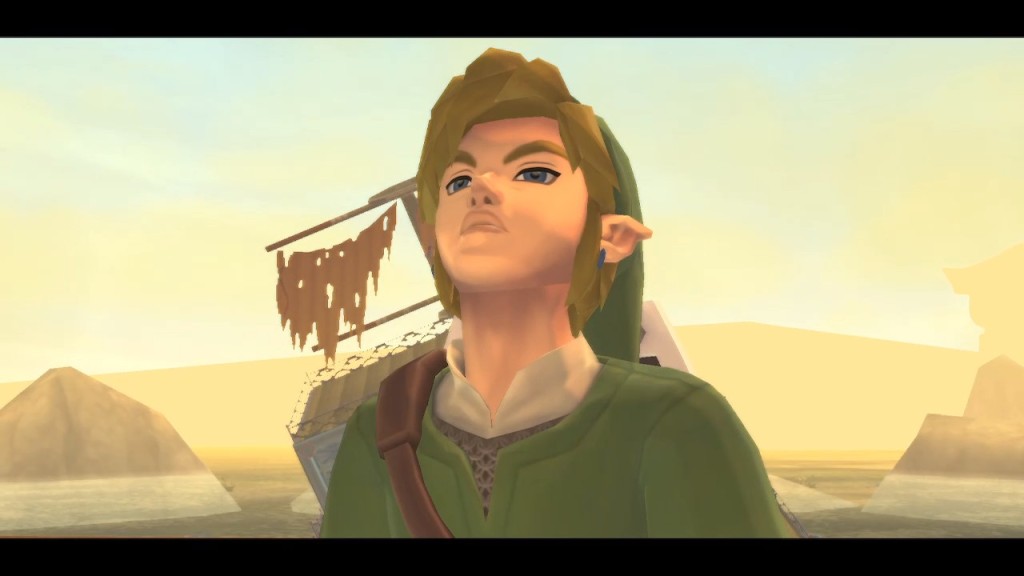
Yes, Link, it’s true.

This left a smaller audience than Nintendo would’ve liked to pick up its latest 3D Zelda extravaganza, the endcap to a year-long celebration of the series’ 25th anniversary. Skyward Sword sold in the millions, but for a game five years in development and an install base as record-shattering as the Wii’s, it was nothing short of a disappointment. The day I started writing this it still held the record for the worst-selling 3D entry in the Legend of Zelda series (Edit: Switch sales may have changed this by now). And despite an initial wave of critical acclaim customary for a Zelda game, the reputation of Link’s motion-controlled escapade took a sharp downturn before long and stayed down for years. After all, who wants to dust off their horrifically outdated Nintendo Wii and buy an extra controller attachment just to challenge the notoriety of a finicky, linear, repetitive, excessively hand-holding game in *ugh* standard definition?

omg ewwwww

Five years. Oh no.

It has somehow been (just over) five years since I put out what is still the longest singular piece of writing I’ve ever cobbled together in my lifetime: A 10,000 word behemoth on The Legend of Zelda: Twilight Princess HD (Edit: Um, about that…). Inspired by a decade of mixed personal feelings, lengthy conversations with friends, and triple-digit hours of watched YouTube content on the strengths and weaknesses of the game; the post ended up perhaps a touch unwieldy and yet oh-so-cathartic. Thanks to a bucket of alternate perspectives and a highly underrated Wii U remaster, I had never felt so assured that – despite its flaws – um, I liked the game, actually.

And I’d be OK never writing another word about it.

The last thing I was thinking as that project slowly came together was “I’m setting a template here and I definitely want to put myself through this again.” And yet you know where this is going, because you read the title: It’s Skyward Sword’s turn. But this time around, dear reader, we’re not investigating if years of Zelda franchise evolution and some neat nips and tucks have improved my sentiments towards an inconsistent videogame; we’re seeing whether my third favourite Zelda game of all-time (behind only Majora’s Mask and Breath of the Wild) can possibly still hold such a lofty position after it has been exposed to a decade of stiff critiques, a lack of clear historical identity and a radical reinvention of the entire franchise in its wake.

Challenge accepted.

But we are going to try our very best to do it in less than 10,000 words this time, probably (Edit: We failed, and we failed hard). Regardless, this one will need a beverage or two to get through; at the time of writing Skyward Sword is the last 3D Zelda game to release on a second console, and rest assured I have no intention of leaving stones unturned. Whatever it will cost.

You guessed it – we’re in for another long one.

(I’m going to go ahead and re-purpose a paragraph from the Twilight Princess post because it fits too well this time, and kinda feels poetic too)

Be aware that this post contains a huge amount of spoilers that get steadily worse the longer you read – worth mentioning if you haven’t played the game before. All you need to know if you’re a Skyward Sword newcomer is that yes, I believe this HD / portable release is definitively the best version of the classic title, and yes, you really should play it. If you really want to read on, continue at your own risk, but you should know that what follows is so exhaustive that you may not even feel like you need to play it by the end. But maybe play it anyway?

HERE WE GO: Click here to regret your choice to click here.

The Seven Stages of Videogame Remakes

It’s been a topic at the forefront of gaming for the entirety of the last generation and a significant part of the one before. The videogame industry these days is old enough to look back and draw from its past, and in an age where some games of yore are ridiculously difficult to experience with anything approaching legality, re-releases and remakes are as commonplace as they are guaranteed to attract online discontent. In many cases, they also represent a near-guaranteed source of revenue for publishers keen on mining nostalgia, so whether you love them, hate them, or pay them no mind until one of your favourites arrives in the spotlight, they aren’t going anywhere.

I’m not here to defend the practice of re-releasing games in various stages, however. Some of that may happen accidentally as I write, but the topic has been covered to death, including on this very blog years ago. KingK also made a pretty good YouTube video on the subject earlier this year that is worth a watch. No, more interesting to me at this very moment is this idea that the quality and validity of some of these re-releases oftentimes seems to hinge on what labels people are willing to attach to each one. As with most things in life, enjoyment is regularly determined by expectation. So I feel like it’s worthwhile to break down and categorise those labels as I see them defined. Because seven is a poetic number that looks great in post headers, that is how I will attempt to divide them. This is all based on my feelings on the topic – and I can definitely see people disagreeing on the order of the categories – but I’ll try to articulate with examples as best I can.
..

Port

Your basic “Take Game A from Platform B and get it to run on Platform C” situation. Nothing more, nothing less. This is regularly seen when a period of platform exclusivity breaks and a title shows up on a competing platform within the same generation, whether that period was motivated by a publishing deal or the game in question was simply developed with one target platform in mind and the ensuing gremlins from the porting process take time to smooth over. Because timed exclusivity within the console space is a rarity nowadays, the platform that is usually either early or late to the party is the PC, but you see more variety of circumstance the lower down you go on the production budget scale. For every big-budget early access title on the Steam/Epic Games storefront, every surprising eleventh-hour Yakuza/Square RPG arrival, there’s a “Nindie” debuting on Switch first, a small ID@Xbox game flying the Microsoft flag straight out of the gate. When these games inevitably cross over to find new homes – grabbing a handy second wave of buzz in the process – they invariably do so without significant gameplay changes or extra content that hasn’t already been added to their initial versions.

The overwhelming majority of PC ports do offer more flexible graphical options due to the open nature of the PC environment (usually related to resolution, frame rate caps/unlocks, and previously unavailable visual effect toggles), just as a huge amount of Switch ports require technical downgrades by very imaginative and talented people in order to run at all (The folks at Bluepoint and Panic Button come to mind). But if that’s all she wrote, you’re looking at a bread-and-butter port between platforms. There are many who hold the untouched port as the most ideal form of game preservation, and many more who don’t see the point of a fresh release of an older game if the developers don’t update anything, but the simple fact remains that basic ports allow more people to play more videogames and they’re an unavoidable part of the landscape.
.

Enhanced Port

These next two categories are where things get muddiest for me, but I’m fairly sure I’ve got my head around them. A game qualifies as an enhanced port in my mind if there has been little to no discernible graphical work done under a game’s hood since it’s original release, thereby qualifying it as a straight port if not for one or two clear and significant gameplay changes that have been implemented. Weirdly enough, this opens the door for re-releases to occur on the same platform as their source material, a practice for which the Kingdom Hearts franchise used to be infamous and something the Pokemon main series continues to do to this day. This is definitely a curious semantic pocket of the industry, because while you can theoretically port a game to the platform it’s already on, without any noteworthy enhancements such an endeavour would be literally pointless.

Of course, most of the qualifiers for this category actually do cross over to new platforms, and as you might expect if you’ve invested in any of their recent consoles, Nintendo features heavily among them. Of late the notoriously port-happy current crop of Big N executives have greenlit a veritable catalogue of exports from the tragic Wii U to the hit-making Switch, packing little more than a resolution bump in the visuals department but almost always carrying a smattering of bullet points to set the new version apart. Hyrule Warriors packs new character skins and integrates content from multiple previous versions of the game, New Super Mario Bros U Deluxe and DK Country Tropical Freeze add new characters and abilities, and Mario Kart 8 Deluxe fundamentally changes the flow of gameplay with more granular kart stats and an extra item slot per player (in addition to new characters). Older examples of this include the Gamecube release of Sonic Adventure 2 with an entire multiplayer mode in tow, the transformed controls and gameplay balance of Resident Evil 4‘s Wii edition and the enabling of the mythical “Stop n’ Swap” functionality in the Xbox 360 version of Banjo-Kazooie.

Continue reading

Best of 2018: Top 10 Disappointments

I have a love-hate relationship with this list. I try and keep it reigned in but really this always ends up as a procession of the things that grind my gears about the entertainment media I consume. There’s no pattern or point to it, but clearly it doesn’t need one because it’s always one of my most read lists. Another thing I also try to do is make this list representative of all three kinds of media I cover here, but I always struggle to come up with genuine worthwhile disappointments in movies and K-Pop – the former because it’s just super easy to avoid movies I hear aren’t worth watching and the latter because it just always feels a bit forced. So this year my Top 10 Disappointments List is finally what its been threatening to be for years – 100% about gaming. Except for the honorable mentions. Um, enjoy?

.
-◊-◊-◊-◊-

VR BEST OF 2018 DISCLAIMER

This list represents my opinion only. I am not asserting any kind of superiority or self-importance by presenting it as I have. My opinion is not fact. If you actually agree with me 100%, that’s odd, but let’s have a beer. Respectful disagreement is most welcome.

-◊-◊-◊-◊-

.

.

10. RDR HDR?

It’s probably best to get this out of the way as soon as possible: This is the only time that Red Dead Redemption 2 is going to show up on this blog over the next two weeks. To be clear, a large part of that is because I don’t get along with the Wild West setting, I’ve never understood Rockstar’s open-world control scheme and despite some beautiful environments and compelling storytelling, I find most of the game’s mechanics unnecessarily obtrusive. I gave it a go anyway because the hype around the game was understandably at fever-pitch and I heard the Xbox One X version would run at a native 4K resolution.

Boy oh boy, does RDR2 look incredible on the X – but from the beginning something was off. The High Dynamic Range calibration in the menus had a maximum luminance of roughly half most modern games and its recommended setting for a display like mine was only a fifth of that maximum (I have one of the brightest sets on the market). I tried five different settings on that slider but I only ever got two impressions – Either the HDR highlights were missing in action or blindingly white. This was particularly noticeable in the game’s prologue, when the snowy surroundings appeared to be literally made of light across entire surfaces. It wasn’t until a Digital Foundry video a few days after launch that my suspicions were confirmed: Despite its beautiful art direction, animation and resolution, the HDR in RDR2 is fake. As it turned out, that utterly baffling tidbit (alongside the fact that my brother ended up finishing the game anyway) was the last straw and I didn’t pick Red Dead Redemption 2 up again.

Continue reading
The Games of Not-2018

2018 felt a little different to me in terms of the way I used my free time on videogames. For whatever reason – be it a less intense schedule of new releases that interested me, weariness of the same old drop-everything-to-play-the-new-thing habits, finally acquiring a decent gaming PC, or a combination of all three – I was somehow more OK with the idea of putting time into older games this year. So I feel like it wouldn’t be a full representation of my 2018 in videogames if I didn’t jot down some quick thoughts on them. I also figured I’d include remasters or re-releases on this page too, just to take some heat off the main list.

I’ve listed the games roughly in the order I played them this year. I’ve also listed either the most prominent initial release version of each game or, where relevant, the version I owned or played back in the day instead. Then on the line underneath I’ve noted the version I played in 2018. Stop looking at me like that, I have to catalogue these things properly.

.

Pokemon Crystal Version

GBC Release: 2001
3DS Virtual Console Release: 2018
How much I played: Start to finish including Kanto, 25+ hrs

I was super-vulnerable to this release when it hit the 3DS eShop in late Jan. There wasn’t much else to play and I was about to head off on a coastal family holiday. The rest I wrote down in its own separate post which you can read here.

.

Final Fantasy XIII

PS3 Release: 2010
Steam Release: 2014
How much I played: The first ten chapters and some messing around in Chapter 11 makes 30+ hrs

Not gonna even try to hide it – seeing this game run in forced 4K on some YouTube video last year was a huge percentage of the reason the dominoes fell and I finally invested in a gaming laptop. After a discussion with a friend about whether FF XIII really did look better than XV in parts or whether that was just our memory of it, I had to jump back in after a decade and it turns out that, despite a truly, ridiculously awful port job, the game’s astonishing art direction sings in higher resolutions. I did play more than half of the game again, hoping to dive into a proper thousands-of-words retrospective, but the gaming calendar moves fast. Near the end of the year Microsoft gave the XIII trilogy a huge Xbox One X-supported backwards compatibility push, so who knows, maybe Square has more plans for a re-release or something. Either way, I will write that post one day. I will.


Continue reading

Best of 2017: Top 15 Games

Here we are. Time to count down my favourite videogames from a truly phenomenonal year for the medium (The best in ten years?). There are some games on this list that I would wholeheartedly recommend to anyone even remotely interested, but the real measure of 2017 is the games that don’t make the list because I just didn’t have time to get into them. And no, I don’t just mean games other people liked but didn’t really grab me. I’m talking Horizon Zero Dawn, Cuphead, Yakuza Zero, Steamworld Dig 2, Night in the Woods, Tales of Berseria, Golf Story, Gang Beasts. Games that in any other year I would have been all over. Games I’ve already seen on many other top ten lists across the internet.

Part of this can probably be attributed to my conscious decision not to ignore good games on the 3DS as long as they were coming out. I clocked nearly 200 hours of combined 2017 playtime on my 3DS according to its activity log – mostly on trains and buses – and if it weren’t for the Nintendo Switch overshadowing it on every big site and YouTube channel I would have been shocked that I wasn’t seeing some of these 3DS games on more people’s lists. Of course, the Switch was still a thing, so there are more Switch games on this page than on any other console. The rest of the numbers are made up by some delightfully surprising indie and triple-A games gripping enough to help me temporarily forget about all the other games I could be playing. What an insane year.

A game qualifies for the list if I play it for over five hours or finish it. You’ll see the platform on which I played each game in parentheses next to its title.

.
-◊-◊-◊-◊-

VR BEST OF 2017 DISCLAIMER

This list represents my opinion only. I am not asserting any kind of superiority or self-importance by presenting it as I have. My opinion is not fact. If you actually agree with me 100%, that’s strange. Intriguing, but strange. Respectful disagreement is most welcome.

-◊-◊-◊-◊-

.

15. ARMS (NS)

Major new IPs from Nintendo are rarer than a PC without Playerunknown’s Battlegrounds installed, so it’s a big deal when one comes along. Following in the spiritual footsteps of 2015’s Splatoon, ARMS is an attempt by Nintendo to refresh what players can expect from a fighting game, in much the same way that Splatoon injected new life into the shooter genre. Taking stylistic cues from Blizzard’s Overwatch in the character design department and infusing these designs with Nintendo wackiness, ARMS is a charming game with deceptive mechanical depth and phenomenonal 1v1 duel multiplayer. Though the rest of its modes are inherently less deep and the game’s single player mode is basic at best, ARMS is my pick for most improved game of the year post-launch, with extra incentives, modes and characters now part of the package. And let’s not forget that theme song, which slots right in alongside Nintendo’s catchiest first-party tunes. ARMS should not be overlooked by anyone buying a Switch.

Continue reading

A Week With Pokemon Silver Version in 2017

I was a few paragraphs into writing this when the SNES Classic came out and ruined everything. I came back to the post afterwards and, naturally, it then turned into several thousand words.

2017 has been an insane year for new release videogames, a fact that has become even more true over the last few months. And yet my most anticipated release date of September 2017 was the 22nd, when Nintendo and the Pokemon Company would – at long last – release Pokemon Gold and Silver on the 3DS Virtual Console (Incidentally just about the only acknowledgement by the big N this year that such a service even still exists – sorry Switch owners). Patched up with wireless trading/battling functionality and wrapped in that gorgeous 3D-compatible faux-Game Boy Color shell, just like Pokemon Red/Blue/Yellow last year, they presented a mouth-watering nostalgic proposition for me on paper. In fact as a testament to the sheer value that “comfort food” media can have, I even purchased and finished the VC version of Pokemon Red a couple of weeks earlier when it went on sale in anticipation of the newer re-releases, even though I had already given my full attention to Yellow in a similar manner in 2016.

Unlike Yellow, I no longer have access to my original Pokemon Silver cartridge, so I haven’t touched the original version in any form for almost fifteen years. In light of all the Pokemon generations that have come and gone in the years since, not to mention the glut of YouTube videos, podcasts and articles on the internet praising the second generation for all its once-groundbreaking qualities, I was more than ready to give Silver another go. And then write something about it, so I could feel less guilty about all the hours spent not doing anything else. This post will probably be a little scattershot in tone, and the “screenshots” will be poor and DIY in nature, but I’ll at least try to keep my thoughts aligned with the order of the game’s events.

Continue reading